
by Paul Sandover
The deities considered here are associated with the Celts, and Druidic nature spirituality. These deities are often of the land and waterways, etc. There are deities of rivers, for example Severina (or Sabrina) of the River Severn. Yet the material presented here can be adapted to deities in other spiritualities or religions, on the common basis of loving connection and universality. Different cultures and individuals will express this in their own way. From very interesting discussions at a one day “One Tree” gathering of Hindus and Druids I’ve discovered that there is some common ground with Druidic spirituality! I view the deities as real and an integral part of daily life, Nature, and my self. Only the bare bones of connecting with deities are offered, as each of us has our own individual path, and people’s experiences with deities are as varied as people themselves. Two people may well have different experiences with the same deity.
When natural features or entities in the landscape, such as springs or mountains, receive human reverence or veneration over a period of time, the feature or entity acquires a level of consciousness that it would not otherwise possess. So, if enough people venerate or honour the feature for long enough, including devising and performing ceremonies, and naming the feature, it is gradually empowered and can become a deity. Perhaps the spring goddess Coventina, who will be discussed later, came into being in this way.
Many years ago, I went on an eight week solo retreat (the first of a number of retreats) on top of an isolated Welsh hill. This is a site for a tree planting project in which I was involved. I lived under canvas, with solar power for radio and music. The site had been clear-felled of a previous commercial crop of Sitka spruce trees. However, there was plenty of unwanted wood lying around for fuel to burn on my wood burner. On the site is a spring which supplied all the water I needed for drinking, and washing body and clothes. This beautiful water is soft and made everything really clean. When collecting water, I developed the habit of thanking the spring. After a week or two, I began making flower offerings to the spring. At the same time a strengthening feeling of gratitude and reverence was felt as I became more aware of the beauty of the spring, and of my need of it for survival. Perhaps this is the very beginning of the process of a natural feature becoming a deity. Imagine a number of people many hundreds of years ago coming upon the land and spring and deciding to settle. If the spring was suitably revered over time, it would become a deity, and most likely given a name.
Why Honour or Venerate the Deities?
Venerating the deities helps to re-empower Nature and the land, and ourselves. It helps us to re-connect with Nature and Great Spirit (the Source, the All), assists with self-realisation (“know thyself”) and can enrich one’s life greatly. More detail will be given later.
Although primarily devotional, this isn’t about mindless grovelling, infatuation, fear or stern duty. It’s about joyous, loving and respectful connection. To a point you get out what you put in, but not necessarily in trying to make “tit-for-tat” bargains. What really matters is offering open and sincere love, trust, appreciation and respect without thought of reward or expectations. This can happen over time. Any “reward” may come in its own time. There can also be the occasional pleasant surprise, perhaps in the form of a sudden insight. Relating with a deity tends to be reciprocal, as the devotional energy of the human empowers the deity a little, and the deity empowers the human. Basically it’s an exchange of energies.
Relationship with deities is inclusive in that a single deity will generally have many followers, just as a human may revere a number of deities. However beautiful the relationship, one is not preferred over other people.
Developing relationship with one or more deities may sound challenging, but is it? We have all shared relationships with family, lovers, friends, and even other species such as dogs. Our experience of relationships with other humans, etc, is invaluable, as relationship with deities is somewhat like these all rolled into one. In a way it’s easier, as deities don’t have egos in the same sense that humans do. Also we have the Higher Self, the Divine Within, which provides a profound potential connection. However, it’s the responsibility of the human to be respectful, open-minded, open-hearted and to keep the ego in check.
Understanding Deities
Trying to understand deities, or a pantheon (a group, or a number of deities, venerated in a single spirituality or religion) of deities, is a very confusing and complex matter. This is because the rational, linear mind can only take us so far. In addition, the vast majority of us are not sufficiently evolved to understand them. We assign names and gender to deities, but to some extent this is an artificial device to enable us to identify with them. However, this works very well, as many people know by experience. The apparent functions of deities in a pantheon can overlap or vary, and the same deity can have more than one name, and they’re often connected. Also, some deities were adopted; for example the Romans adopted and renamed some ancient Greek deities. In addition, the Sun may be considered feminine and the Moon masculine in a few circumstances.
Pantheons are never as well defined as they may at first appear. In the Celtic pantheon, local deities are interrelated aspects or facets of the deities of the land, and Earth (the “mother goddess”), more generally. In venerating a local deity, the “greater” aspect of deity is also being honoured.
To begin, one can do some research on the deity in question. Myths, legends, old texts and scriptures are popular and can provide insight and inspiration. Owing to the complexity (and often ambiguity) of such material, I only dip my toes in these waters. Generally my preference is for modern books on spirituality written in plain, modern English. Good books of this kind inspire and can be read with both mind and heart.
I start by finding out some of the “attributes” for the deity in question. This is, broadly speaking, a rather simplified approach to working formally with deity as archetype. (The subject of archetypes is complex and is not discussed here). For example, the attributes for the goddess Brighid (Brigit or Brigid) include crafts (particularly smithing), healing, poetry and she’s associated with fire. This is only a starting point as one may discover other attributes of a particular deity over time. For example I feel that Brighid has a warrior aspect, although this isn’t normally attributed to her. It’s best not to try to overly define or limit things, especially as all this is potentially part of the process of self-realisation. Self-realisation is, broadly and simplistically speaking, the discovery of the boundlessness of the self, of one’s humanity; and development of connection with the Higher Self/Great Spirit. Our temporal existence as perceived by the conscious mind and physical senses is only the tip of the iceberg as regards the fullness, beauty and breadth of one’s being.
A search can be undertaken to see if there’s any known archaeological or historical evidence. Internet searches are perhaps the quickest way to find such information. As always with the net, cross-check a number of sites for the sake of accuracy. There are also accounts of people’s experiences with deities to be found.
It has been said that the deity finds you rather than the other way round. There’s truth in this, but it can work both ways; it takes two to develop relationship. Be guided by what deity attracts you, by intuition, feeling, and synchronistic events (coincidences with meaning) which are often small but can lead to greater things. The call of a bird, a gust of wind or the sudden movement of a wild animal may be a nature deity speaking. An open and loving approach is a great help. Patience is also an asset; developing relationship can take time. Remember to enjoy the journey and not regard it as a means to an end! In my practice (which is really an integral part of daily life) love, meditation and inner journeying are of greatest importance.
Meditation as a Way of Encountering a Deity
The following meditation/inner journey is one way of encountering a deity. The mind needs to be as relaxed and calm as possible, as anxiety or too much expectation will greatly reduce any chance of success in this or any other meditations of this kind. It may need to be repeated a number of times. Allow up to about 30 minutes. Alternatively you can make up your own, or modify this one if you wish. Try to really live the scene – the scents, sounds, what you see, etc. Recording it may be helpful. This, or a similar journey can also be used to meet animal guides, etc.
Close your eyes and spend a few minutes relaxing your body, particularly around the neck and shoulders. Try to let go of any worries and calm the mind. Imagine you’re walking down a footpath in the countryside and arrive at a gate. Open the gate, walk through, then close the gate. Before you the footpath runs through a beautiful meadow. The blooms of bright yellow buttercups, and white and purple clover raise their lovely faces to the blue sky. The gentle breeze caresses your hair and you feel the kiss of the Sun on your skin. Subtle summer scents grace the warm air. After crossing the meadow you arrive at a stile leading into a wood, with a noble Oak either side. Cross the stile and follow the path into the wood. Tall trees tower above you, their leafy crowns giving shade and whispering in the breeze. Birds joyfully sing their praises to the Sun. You arrive in a small glade and settle on the soft grass, awaiting the arrival of a deity. After a while, you see him or her approach you from amongst the trees. You stand up and respectfully introduce yourself and await a response. (At this point follow your intuition if possible and let events flow). After a while you offer thanks and part, and happily walk back along the path through the trees and cross the stile. Follow the footpath through the verdant meadow and through the gate.
Slowly open your eyes and feel your feet firmly on the floor and ground yourself. A cup of tea and a snack will help you return to the present.
After Meditation
Here are some checks to help establish whether one is deluded or has met an inauthentic or false guide, and these checks can be applied to any teaching you encounter as well:-
1. Does the guide or teaching insist you must follow it exclusively, or lose your way?
2. Does the guide say you are the second coming, or something similarly extravagant?
3. Does the guide inhibit free will; the capacity to think and act for oneself?
If the answer to any of the above is “yes”, it’s probably best to say a firm yet polite goodbye and have no further involvement.
Deities are mysterious and seemingly paradoxical. A deity can give “personal” attention to a number of people simultaneously, and be in different places at the same time. They’re not bound by space and time in the way humans in the temporal, “everyday” world are. Inner journeying enables humans to leave the temporal world, in a broadly meditative state. In effect, deities are energy fields, or “forces of nature”. Humans are essentially energy fields, but of a different nature. The deities are totally detached by human standards. If, through karma or stupidity a hard lesson has to be learned, we may or may not have a prayer answered or receive any support. In any case the response, if any, to a prayer may not be what one expects and can happen in its own time.
The deities associated with the dissolution and death of the body and certain aspects of the human psyche tend to be feared, but this is a reflection of our fear of death. It is not necessary to fear such deities, but it’s worth being really respectful! In fact death leads to rebirth onto the next turn of the spiral of our existence as beings.
Honouring the Deities
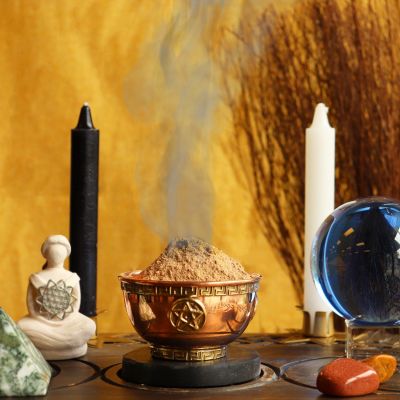
A very pleasant way of honouring the deities is by creating an altar. This does not need to be complex or large and can even be placed on a shelf, and items that represent the deity or deities of your choice can be placed upon it. The altar can be placed in practically any room; an altar to a water deity could be placed in the bathroom for example. I’ve even made a tiny altar for when I go to camps, etc. Crafting small items for an altar by hand can be most enjoyable, whilst thinking loving thoughts of the deity in question. They don’t need to be masterpieces, as it’s the intent that counts. A song, chant or poem can be written to honour a deity. Working with deities tends to be a circle in many ways. A deity can inspire one to produce something really nice, develop skill and feel satisfaction.
Intuitive Methods to Connect with Deities
So far, matters have been discussed on the level of mind. We will now move towards the more intuitive, heart –related aspect of connecting with deities with a specific example. Please remember that everybody’s perception of a given deity is unique to a point, and that the following example has limited instructional value in itself. However, it illustrates many of the points made above, and hopefully gives some idea of the amazing quality of love that can be experienced, or rather, shared.
Example
Coventina, an ancient Celtic goddess of wells and springs, and I share a particularly intimate, consistent and truly loving relationship. Her main attributes are said to be abundance, gentle inspiration, purification, new beginnings, prophecy and birthing. I find her to be loving and generous in addition. There is some debate as to whether she is a healer; however, she has given me healing on a number of occasions. For more about Coventina, see her entry in the OBOD online library.
For many years I’ve had a particular liking for springs, since spending long solo retreats in a remote place in Wales some years ago. I bought a figurine of Coventina at a camp in August 2011 because it attracted me, and it found a home on my altar. Later, I did some research to find out about her. A number of inner journeys followed, and I connected with her. Some months later whilst journeying, she showed me a lovely spring running into a small, misty pool. I was invited to bathe in the pool, and this is where Coventina gives me healing. A dip usually restores my good spirits and sometimes I feel great. In a sense, Coventina is the water. More recently, she opened a portal to the oceans via her pool, where over time I started to feel the wondrous unconditional love of the world’s waters. As her golden threads are woven into my being, her lovely presence and companionship can often be felt by just thinking of her, if my mind is clear.
Knowing her is a beautiful blessing, but I make no rash promises. I’ve written both a poem and a chant to Coventina, perhaps under the influence of her gentle inspiration. Coventina is detached in that she leaves me to make my own mistakes and face the consequences, although she may give me gentle support. This is right, as my behavior is my responsibility. It appears that she’s not concerned about my faults; what matters is my integrity, and the quality and truth of my love with respect to her, and all life. However beautiful the relationship, one is not preferred over other people who venerate her, as is usually the case with deities.
It may seem surprising that someone living in south Worcestershire is connecting with a goddess from so far away, but deities transcend linear distance. I know someone who connects with a Celtic deity from France! Note the synchronicity around my long acquaintance with springs, and finding a figurine of a lesser known deity. Please remember that the above described relationship with Coventina is unique to my spiritual path.
It seems that some people connect with a deity whose attributes are compatible with their particular personality traits and their spiritual path, and that their experiences are vastly different. Connection with deity can include love, inspiration, empowerment in various forms, guidance, healing and support in times of difficulty.